

Essential Tips for Moving House: A Stress-Free Guide
by Mae Osz on Sep 04, 2025
Moving house is widely regarded as one of life's most stressful experiences, but it doesn't have to feel that way. The difference between a chaotic move and a calm one almost always comes down to preparation — knowing what to do, when to do it, and in what order. In this guide, you'll find practical tips for moving house that cover every stage of the process, from the first sort-through of your belongings right through to making your new place feel like home.
By Mae Osz | Interior Design Consultant & Home Decor Expert with 12+ years of experience.
Moving house always makes the list of life’s most stressful events? In this blog we will explore the most valuable moving advice to help you stay organised and calm.
It’s no wonder—before you’ve even packed a single box, the to-do list feels endless and overwhelming.
But here’s the good news: up to 80 percent of that moving day stress can actually be avoided with a bit of smart planning ahead of time. Most people put all their energy into booking removal vans and stocking up on packing tape, but the real secret to a calmer move starts much earlier.
By taking a little time to sort through your belongings first, you’ll not only save yourself headaches later but also discover simple tricks that make the whole experience feel so much lighter and more manageable.
List of Contents
- Smart Packing Tips for a Smooth Move
- Organising a Seamless Moving Day
- Setting Up Your New Space Efficiently
- Pro Tips
- More About
- Moving House Checklist: What to Do and When
- Cost of Moving House: What to Budget For
Smart Packing Tips for a Smooth Move
Moving house requires strategic planning, and mastering room-specific packing techniques can transform a potentially chaotic experience into a smooth transition. Whether you’re moving across town or to a new country, understanding how to pack efficiently will save you time, reduce stress, and protect your cherished belongings.

Strategic Preparation: Decluttering and Sorting Before You Move
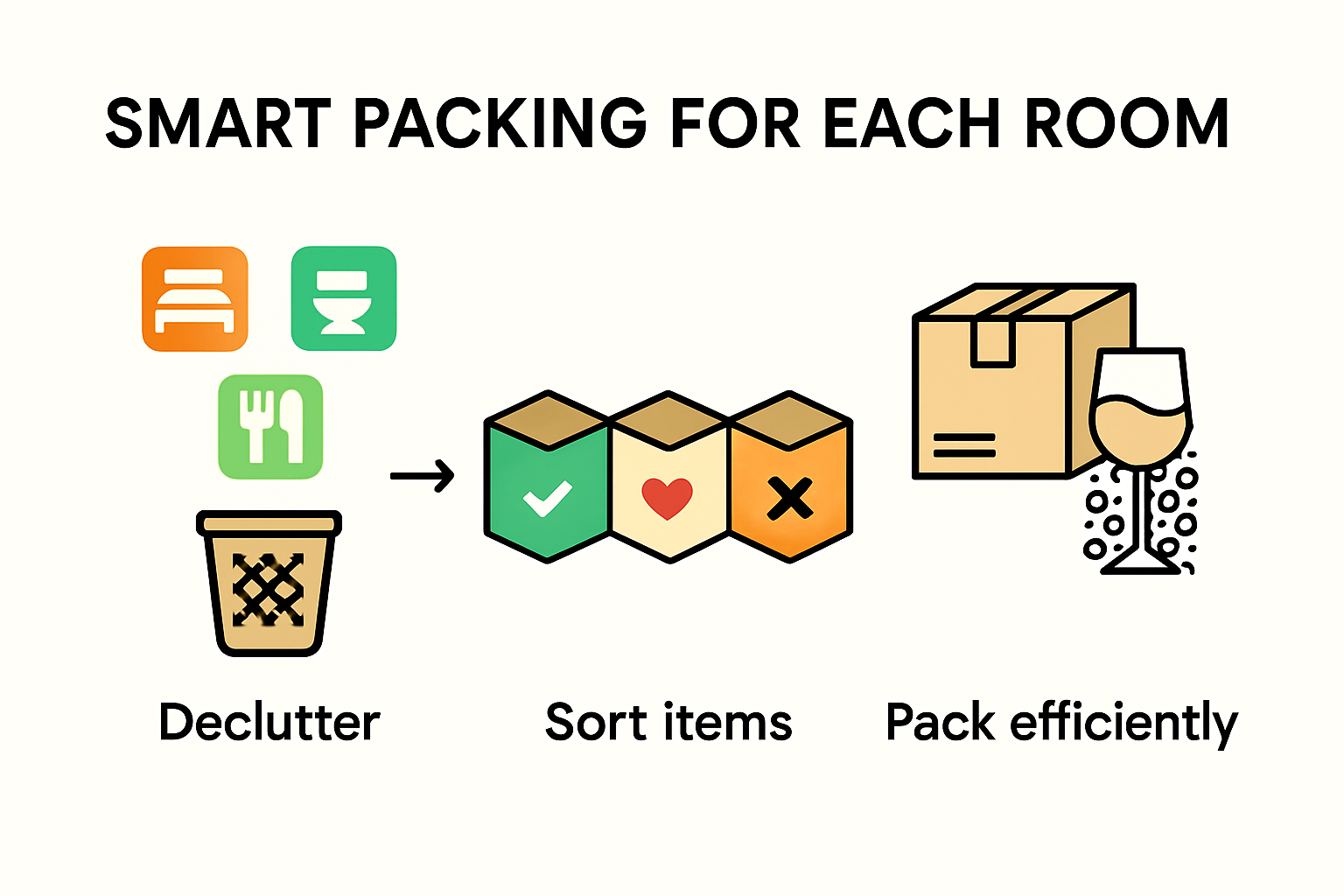
Before diving into packing, the most crucial step is decluttering. University of California, Berkeley recommends a systematic approach to sorting your items. Start by creating three distinct categories: keep, donate, and discard. This method not only reduces the volume of items you’ll need to pack but also simplifies your moving process.
When sorting through your possessions, be ruthless yet practical. Ask yourself critical questions: Have I used this item in the past year? Does it hold significant sentimental value? Would it be more cost-effective to replace this item than transport it? By answering these questions honestly, you’ll streamline your packing process and potentially save on moving costs.
To help you efficiently decide what to keep and what to let go when decluttering, here is a checklist table you can use during the initial sorting process.
| Item Consideration | Used in the Past Year | Sentimental Value | Replace Instead of Moving | Keep/Donate/Discard |
|---|---|---|---|---|
| Have I used this in the past year? | [Yes/No] | — | — | Yes |
| Does it hold sentimental value? | — | [Yes/No] | — | Yes |
| More cost-effective to replace? | — | — | [Yes/No] | Yes |
| Final decision | — | — | — | Keep/Donate/Discard |
Room-by-Room Packing Guide
Kansas State University offers invaluable insights into efficient packing techniques. For kitchen items, use robust boxes and wrap fragile crockery and glassware individually. Utilise soft items like tea towels and oven mitts as padding to provide extra protection. In the bedroom, consider keeping clothes on hangers and wrapping them in large garbage bags to maintain their shape and cleanliness during transit.
For home offices and living areas with electronics, take extra precautions. Photograph the cable configurations of complex setups like entertainment systems before disconnecting, which will help you reassemble them correctly in your new home. Original packaging for electronics is ideal, but if unavailable, use bubble wrap and sturdy boxes, ensuring minimal movement during transportation.
Efficient Packing Techniques and Organisation
The University of Illinois Springfield emphasises the importance of strategic packing. Use resealable plastic bags for liquids to prevent potential leaks. Fill every container to maximise space efficiency, but be mindful not to overload boxes, which could lead to breakage or make them too heavy to lift safely.
Consider creating a dedicated packing zone in your home where you can systematically pack and label boxes. Use clear, descriptive labels indicating both contents and the room they belong to. Pro tip: Create a colour-coded system or number your boxes to make unpacking more straightforward.
A final, critical recommendation is to pack a personal essentials bag containing items you'll need immediately upon arrival: toiletries, a change of clothes, important documents, chargers, and basic kitchen supplies — and if this is your first move, our guide to setting up your first apartment will help you hit the ground running once you arrive. This approach ensures you’re not frantically searching through numerous boxes when you first arrive at your new home.
Remember, successful moving is about preparation, organisation, and a positive mindset. By implementing these smart packing techniques, you’ll transform what could be a stressful experience into a manageable and even exciting transition.
Organising a Seamless Moving Day
Moving day represents the culmination of weeks of preparation, and strategic organisation can transform a potentially stressful experience into a smooth transition. Success hinges on meticulous planning, clear communication, and proactive problem-solving.
Preparing for the Moving Day Logistics
Federal Motor Carrier Safety Administration emphasises the critical importance of understanding your rights and responsibilities during the moving process. Before the big day, confirm all details with your moving company, including arrival time, estimated duration, and specific handling instructions for fragile or valuable items.
Create a comprehensive moving day kit containing essential items: important documents, basic tools, phone chargers, medications, snacks, and a first-aid kit. This preparation ensures you’re equipped to handle unexpected situations and maintain your comfort during the transition. Keep this kit with you personally, rather than packed in moving boxes, to guarantee immediate access.
Coordinating Practical Moving Logistics
City of Boston’s moving guidelines recommend securing practical logistical details well in advance. If you’re moving in an urban area, reserve parking for moving trucks by obtaining necessary street occupancy permits. This prevents potential parking tickets and ensures a smooth loading and unloading process.
On moving day, establish clear communication channels with your moving team. Walk them through your home, highlighting items requiring special care, pointing out potential challenges like narrow hallways or delicate flooring. Provide clear instructions about which items should be handled with extra caution and which rooms items belong in at the new location.

Final Checks and Transition Strategies
University of Pittsburgh’s Off-Campus Student Services recommends conducting a thorough final walkthrough of your previous residence. Check every room, cupboard, and storage space to ensure nothing is accidentally left behind. Take photographs of the empty space for your records, which can be useful if you’re renting and need to document the property’s condition.
Maintain a calm and organised demeanour throughout the moving process. Your attitude will help keep the moving team motivated and focused. Be prepared to make quick decisions, but also remain flexible. Unexpected challenges are part of moving, and your ability to adapt will significantly reduce stress.
Consider having a basic cleaning kit on hand for immediate tidying at both your old and new locations. This allows you to quickly address any minor messes and ensures a more pleasant moving experience. Additionally, have a plan for immediate essentials in your new home: know where you’ll place critical furniture, set up basic kitchen and bathroom functionality, and create a comfortable first-night environment.
Below is a process table outlining key steps and actions for an organised and successful moving day, based entirely on the article’s recommendations.
| Step | Action | Key Details |
|---|---|---|
| Confirm movers & responsibilities | Verify details with moving company | Arrival time, duration, fragile item handling |
| Prepare moving day kit | Assemble essentials for immediate needs | Documents, tools, chargers, snacks, medication |
| Reserve parking/logistics | Secure street permits and parking for moving vans | Prevent tickets, ensure smooth loading/unloading |
| Walkthrough home with movers | Point out fragile items/special instructions | Identify challenges (narrow halls, delicate flooring) |
| Final walkthrough of old home | Check for forgotten items, take photos for records | Every room, storage, cupboards |
| Basic cleaning | Clean both old and new spaces as needed | Bring cleaning kit for quick tidying |
| First-night setup | Arrange essentials at new home for comfort | Furniture placement, kitchen/bathroom ready |
Remember, a successful moving day is not about perfection but about strategic preparation and maintaining a positive outlook. By implementing these comprehensive strategies, you’ll transform what could be a chaotic experience into a well-orchestrated transition to your new home.
Setting Up Your New Space Efficiently
Once the boxes are unpacked, making each room work for your lifestyle becomes the priority — our tips on decorating a small bedroom in your new home are a great place to start if you're working with a compact space.
The initial setup process is crucial in transforming an empty space into a personalised sanctuary that reflects your lifestyle and meets your practical needs.
Strategic Space Planning and Organisation
Efficient space setup begins with thoughtful planning and strategic organisation. Before unpacking everything, take time to visualise each room’s potential layout. Rio Grande Credit Union recommends optimising your space by considering natural light, traffic flow, and functional requirements for each area.
Start by positioning larger furniture pieces first, creating a framework for smaller items. Consider each room’s primary function and arrange furniture to support that purpose. In living areas, create conversation zones that encourage interaction. In bedrooms, prioritise comfort and relaxation by positioning the bed to maximise natural light and provide easy access.

Creating an Energy-Efficient and Sustainable Environment
Connecticut Department of Energy and Environmental Protection emphasises the importance of incorporating sustainable practices during home setup. Choose resource-efficient materials and consider long-term energy consumption when selecting appliances and lighting fixtures.
Implement energy-saving strategies from the beginning. Virginia Energy Sense suggests taking advantage of natural daylight, installing LED lightbulbs, and setting thermostats to optimal temperatures. Consider using smart power strips to reduce phantom energy consumption and select energy-efficient appliances that will lower your utility bills.
Personalising and Optimising Your Living Space
While functionality is crucial, personalisation transforms a house into a home. Unpack rooms systematically, focusing on creating comfortable and meaningful spaces. In the kitchen, organise items based on frequency of use, placing everyday kitchenware in easily accessible locations. In home offices, ensure proper ergonomic setup with adequate lighting and comfortable seating.
Don’t rush the process of settling in. Take time to experiment with different arrangements, allowing your space to evolve organically. Consider temporary solutions like modular furniture or versatile storage options that can adapt as you understand your new home’s unique characteristics.
Remember that efficient space setup is an ongoing process. Be prepared to make adjustments as you learn how you naturally use each room. Pay attention to how light changes throughout the day, how traffic flows through spaces, and how your lifestyle interacts with your new environment.
Ultimately, creating an efficient living space is about balancing practicality with personal expression. By approaching your new home’s setup with intentionality, creativity, and a focus on sustainability, you’ll craft a space that not only meets your functional needs but also nurtures your well-being and reflects your individual style.
Moving House Checklist: What to Do and When
One of the most searched-for resources when relocating is a clear, timeline-based checklist — and with good reason. Breaking your move into distinct phases removes the paralysing feeling that everything needs to happen at once.
8 weeks before: Book your removal company or van hire, begin decluttering room by room, and research schools, GPs and dentists near your new address.
4–6 weeks before: Notify your bank, employer, DVLA, HMRC and subscription services of your new address. Start collecting quality packing boxes and materials.
2 weeks before: Confirm utility suppliers for your new home, arrange mail redirection via Royal Mail, and begin packing non-essential items.
Moving week: Defrost the freezer, confirm the removal team's arrival time, pack an essentials bag with toiletries, chargers, documents and a kettle, and do a final walkthrough of every room.
After moving in: Check all meters, test smoke and carbon monoxide alarms, and update your address on the Electoral Register at gov.uk.

Cost of Moving House: What to Budget For
Understanding the likely cost of moving house helps you avoid nasty surprises and plan your finances with confidence. Costs vary considerably depending on the size of your home, the distance involved, and the services you choose.
Removal company: A local one-bedroom move typically costs £300–£600; a four-bedroom long-distance move can reach £1,500–£3,000 or more.
Packing materials: Budget £50–£150 for quality boxes, bubble wrap, tape and labels — or ask local supermarkets and off-licences for spare boxes to reduce this cost.
Storage: If there is a gap between leaving and arriving, self-storage units average £20–£60 per week depending on size and location.
Cleaning: End-of-tenancy or pre-move-in professional cleaning typically costs £150–£400.
Utilities and admin: Factor in Royal Mail redirection (from around £33 for three months), council tax overlap, and any early exit fees on existing broadband or energy contracts.
Getting three written quotes from reputable removal companies is always worthwhile — prices can vary by 30–40% for the same job.

How Long Does It Take to Move House?
The time it takes to move house depends on where you are in the process. From the day an offer is accepted to the day you collect the keys, the UK average is 12–16 weeks — though the conveyancing process alone can take 8–12 weeks when a mortgage, survey and searches are involved.
The physical move itself — loading, transit and unloading — typically takes one day for a one- or two-bedroom property and two days for larger homes. If you are packing yourself, allow at least two full weekends of packing time for a three-bedroom house.
Delays are common. The most frequent causes are slow solicitors, incomplete documentation, mortgage valuation issues, and chain complications. Building in extra time at each stage and chasing your solicitor proactively keeps things moving.
Pro Tips
Moving into a new home is stressful, but it doesn’t have to be chaotic. With the right mindset and strategies, you can make it feel manageable—and even exciting. For more expert advice, visit our Content Hub.
You might also enjoy:
More About
Want more guidance on managing a stress-free move? Take a look at The Spruce’s Complete Moving Guide, which covers timelines, checklists, and room-by-room advice to help you stay organised from start to finish.

WATCH: the ultimate moving out CHECKLIST 📦: girl talk, budgeting & planning 💸🏡


