

Modern Wall Art Ideas to Refresh Any Space
by Mae Osz on Aug 13, 2025
Wondering which modern wall art ideas will actually work in your home — rather than just look good on a mood board? The right piece can anchor a room, set the mood, and reflect your personality, but with so many styles and formats available, knowing where to start is half the battle. Whether you're drawn to bold abstract canvases, understated line prints, or a curated gallery wall, this guide gives you practical, room-by-room advice to help you choose art you'll genuinely love living with.
By Mae Osz | Interior Design Consultant & Home Decor Expert with 12+ years of experience.
I used to think a sofa, a rug, and a coffee table were enough. But then I hung my first statement print, and everything changed. It wasn’t just a picture on a wall; it was a mood setter, a conversation starter, and, quite honestly, the missing piece of the puzzle. The right wall art doesn’t just decorate a room — it transforms it.
I know first-hand that picking the right artwork can be tricky. It’s not just about matching your cushions or filling empty wall space; it’s about bringing your personality into your home in a way that feels authentic. So, let’s explore how modern wall art ideas can work wonders in your space, whether you’re styling a cosy flat or a bright, open office.
List of Contents
- Choosing Wall Art That Works for Your Space
- Creative Ways to Display Wall Art
- Current Wall Art Trends for Modern UK Interiors
- Wall Art for Homes and Offices: What Works Where
- Choosing Wall Art by Room: A Practical Guide
- How to Style a Gallery Wall
- Wall Art Inspiration: Styles to Try in Every Room
- How to Hang and Position Wall Art Correctly
Choosing Wall Art That Works for Your Space
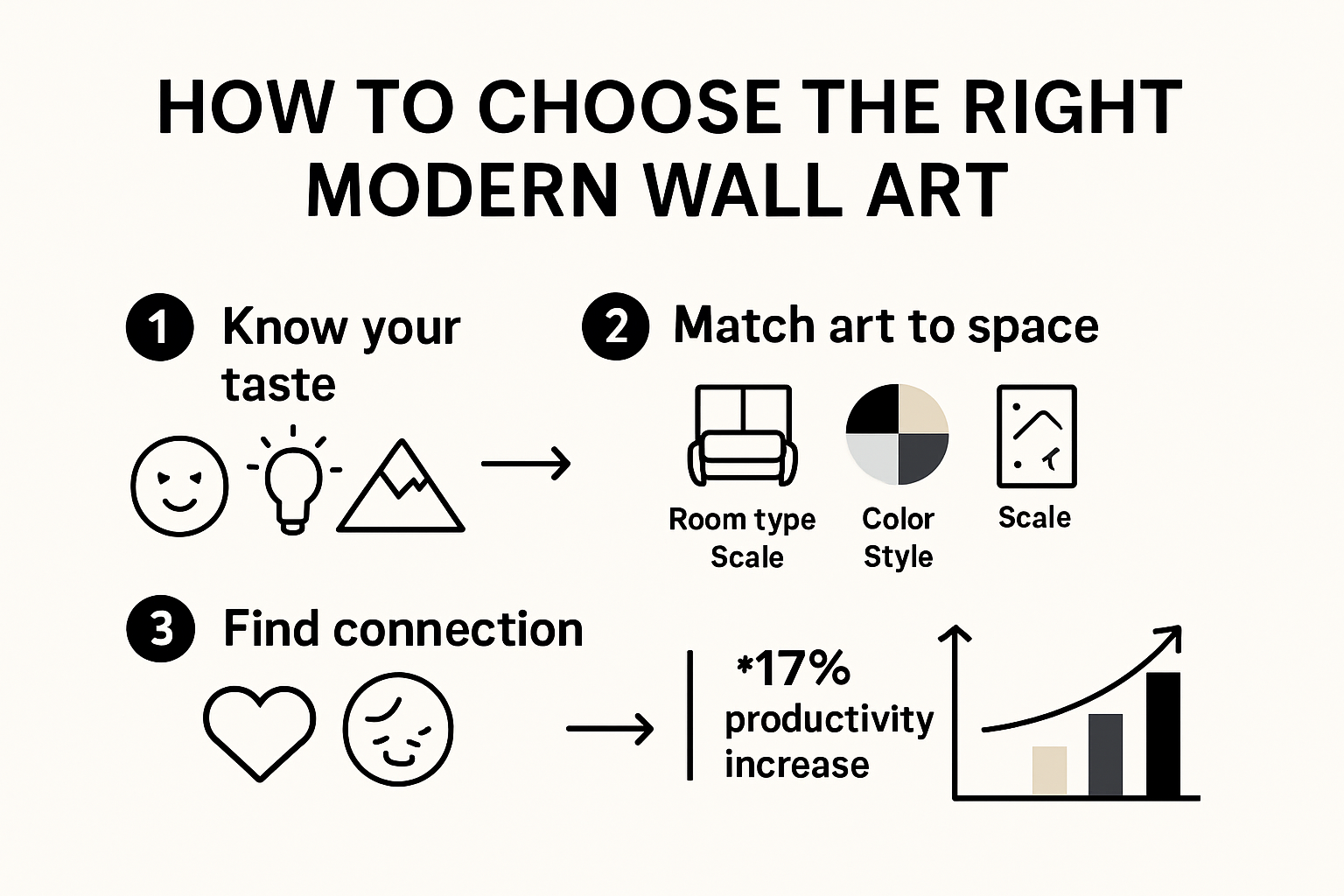
Whenever I choose a new piece, I think about three things: my personal style, the space it’s going into, and how it makes me feel. Your home is your story, and your art is one of the best storytellers you can invite in.
Understanding Personal Art Preferences
Over the years, I’ve noticed how deeply personal art choices are. Friends who love travelling are drawn to vibrant photographic prints, while my minimalist mates lean towards clean, abstract lines. Your taste is shaped by your experiences, your memories, and even your personality. For example:
When I help clients choose artwork for their home, I always ask, "Does this make you smile every time you walk past it?" If the answer is yes, you’re halfway ther

Matching Art to Your Space
Your room already has its own personality — through its colours, shapes, and textures. I once helped a friend decorate her Victorian terrace. The high ceilings and ornate coving were perfect for oversized canvas art with deep, moody colours. In a smaller, Scandi-style flat, lighter tones and airy frames felt right — much like the approach covered in this guide to sitting room art and focal points and how to anchor a room with the right centrepiece. Think of your art as a handshake between the room and your style.
One golden rule: scale matters. Large, empty walls crave big, bold statements. Small nooks benefit from smaller, more intricate pieces. If in doubt, lay your artwork on the floor in front of the wall to test the proportion before hanging.
Emotional and Personal Connection
I have a print in my hallway that reminds me of a trip to Kyoto — cherry blossoms in full bloom — and that personal connection is what makes wall art so powerful. Every time I see it, I’m right back on that quiet street, camera in hand. That’s the magic of art. If a piece makes you feel something — nostalgia, joy, calm — then it belongs in your home.
| Personality Trait | Art Style Often Loved |
|---|---|
| Adventurous & Outgoing | Bold, colourful abstracts |
| Calm & Reflective | Minimalist line work or nature scenes |
| Sentimental | Photography and travel prints |
| Creative Thinker | Surreal or mixed-media pieces |
To better understand how personality traits and demographics influence art preferences, the table below summarises key findings mentioned in the article:
| Factor | Preference Tendency |
|---|---|
| Openness to Experience | Favour complex and intricate artworks |
| Conscientiousness | Prefer simpler, structured designs |
| Gender: Women | Choose vibrant, happy, and straightforward paintings |
| Gender: Men | Opt for geometric and more complex compositions |
| Younger Age | Less appreciation for intricate artwork (preferences evolve with experience) |
| Older Age | Greater appreciation for intricate artwork |

Creative Ways to Display Wall Art
Hanging a picture in the middle of the wall isn’t the only option. The way you display Modern Wall Art can be just as exciting as the art itself.
Unconventional Display Techniques
Have you thought about placing art in unexpected places? I once styled a kitchen with a framed botanical print right above the spice rack. In another project, a landscape photograph hung above the bath — protected behind glass, of course. If you work from home, you may also find useful inspiration in these study room decor ideas that cover everything from colour choices to art placement for productivity. These little surprises spark conversation and make your home feel playful.
Picture ledges are another favourite of mine. They let you layer and swap out pieces without making more holes in the wall. I’ve used them in my studio so I can change the mood whenever I like.
Thematic and Layered Presentations
Grouping art by theme or colour can make even mismatched frames look intentional. For example, in my living room I have a “coastal” wall — all blues, creams, and sandy tones.
Layering tip: Start with one large anchor piece, then add smaller works around it. Overlap frames slightly for depth. Here’s a quick reference table:
| Technique | Visual Effect |
|---|---|
| Symmetrical grid | Calm and orderly |
| Overlapping layers | Depth and energy |
| Colour grouping | Cohesive storytelling |
Interactive and Dynamic Displays
Technology has crept into art in a wonderful way. Digital frames mean you can change your artwork daily — perfect for those of us who like variety. I also love magnetic walls in children’s rooms, where artwork can be moved around easily.

| Display Method | Description | Key Benefits |
|---|---|---|
| Picture Ledges | Shelves for layered/framed art display | Flexibility, easy rotation, no new wall holes |
| Thematic Grouping | Arranging art by theme, colour, or style | Cohesive story, visual harmony |
| Layering Artwork | Overlapping or stacking multiple pieces | Added depth and dynamic impact |
| Digital/Interactive Walls | Digital frames, magnetic layouts, or writable sections | Evolving displays, personalisation, engagement |
| Floating Shelves | Displaying 3D objects alongside 2D work | Multisensory experience, diverse media mix |
Current Wall Art Trends for Modern UK Interiors
Trends aren’t just about style; they often reflect what matters to us. Right now, Modern Wall Art is embracing some beautiful shifts.
Sustainability and Eco-Conscious Design
I’m seeing more artists working with recycled wood, organic cotton canvases, and plant-based inks. One of my favourite recent finds was a set of prints made from natural dyes — gorgeous to look at and kind to the planet.
Digital and Technological Integration
Art no longer has to be static. From animated digital prints to QR codes that play music when scanned, technology is changing the way we interact with our walls.
Diverse Artistic Expressions
We’re celebrating variety more than ever — from bold African-inspired patterns to minimalist Japanese line art. Personalisation is huge too. Commissioning a piece means you’ll own something no one else has, which makes your home even more you.


Wall Art for Homes and Offices: What Works Where
Productivity and Psychological Impact
When I first added art to my office, I didn’t expect much. But I noticed I worked longer and felt calmer. Studies back this up — art can boost productivity and reduce stress. For a home office, choose images that energise you in the morning and keep you inspired through the afternoon slump.
Research from Exeter University’s School of Psychology reveals a compelling connection between art and workplace performance. Employees working in spaces decorated with art experienced a remarkable 17% increase in productivity compared to those in unadorned environments. This finding underscores the profound psychological influence of thoughtfully selected artwork.
In home offices, this principle becomes even more critical. Wall art can create visual breaks, reduce stress, and stimulate mental engagement. Choose pieces that resonate with your professional identity and personal aesthetic, creating a space that motivates and inspires you throughout your workday.
Diverse Art Styles for Professional Spaces
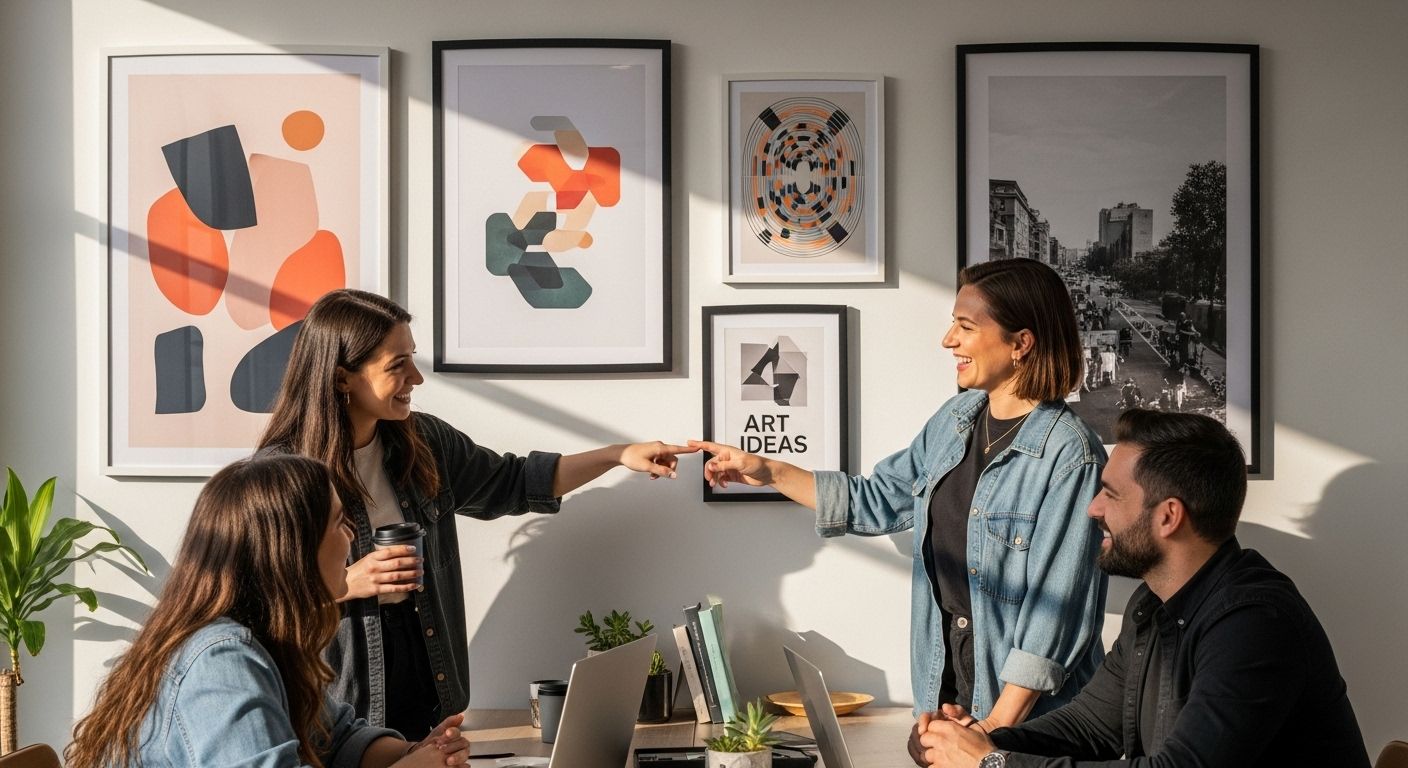
Corporate doesn’t have to mean boring. I’ve helped offices use bright abstracts in meeting rooms to inspire creativity, and calming nature prints in break areas for relaxation.
Office design experts recommend a diverse range of modern art styles suitable for professional environments. Graphic prints, cityscapes, nature-inspired art, typography-based pieces, abstract compositions, minimalist illustrations, and inspirational posters can all contribute to a dynamic workspace.
If you're also thinking about artwork for a workspace, our guide to study room decor ideas for a productive workspace covers how to choose pieces that support focus without sacrificing personality.

Innovative Wall Art Strategies
Think beyond frames. Green walls, chalkboard sections, or floating shelves with a mix of books, plants, and art can make your workspace feel alive.
Interior design specialists suggest innovative approaches to wall art that extend beyond traditional framed pieces. Introducing a green wall can simultaneously improve air quality and aesthetic appeal, reducing stress and enhancing mood. Floating shelves offer versatile display options for books, awards, plants, or decorative items, maintaining an organised and visually interesting space.
A chalkboard wall presents a creative and flexible element, perfect for spontaneous brainstorming, note-taking, or collaborative ideation. This approach transforms your wall from a static surface into an interactive workspace that encourages creativity and dynamic thinking.
Remember that modern wall art in homes and offices is not just about filling empty space. It’s about creating an environment that reflects your unique personality, stimulates creativity, and supports your professional and personal goals. Experiment with different styles, mix media, and don’t be afraid to let your walls tell your story.
Choosing Wall Art by Room: A Practical Guide
Different rooms call for different approaches, and understanding how each space functions will save you from costly mistakes. A bold, oversized canvas that looks magnificent in a large open-plan living room may feel suffocating in a narrow hallway.
Living room: This is your showcase space. Go for a statement piece above the sofa — something at least two-thirds the width of the furniture beneath it. Abstract prints, landscapes, or a curated sitting room art grouping all work brilliantly here.
Bedroom: Calmer tones and softer imagery tend to work best above the bed. Think botanical prints, abstract washes, or simple line art. Keep the scale proportionate — artwork should span roughly 50–75% of the headboard width.
Hallway: A narrow hallway benefits from vertically oriented prints or a staggered gallery arrangement that draws the eye along the corridor. Lighter tones and simple compositions stop the space feeling cramped.
Home office: Art in a workspace should motivate without distracting. Typographic prints, architectural photography, or structured abstract work tend to support focus rather than undermine it.
How to Style a Gallery Wall
A gallery wall is one of the most effective ways to fill a large expanse of wall, and it does not require an interior designer or a huge budget. The key is planning before you put a single nail in the plaster.
Start by laying your chosen prints on the floor in the arrangement you want, then photograph them from above. This gives you a clear blueprint to work from. Aim for consistent spacing — around 5 to 8 centimetres between frames — and decide early whether you want a structured grid or a more organic, salon-style spread.
Mix frame finishes deliberately: a combination of natural wood, matte black, and thin gold frames creates visual interest without looking chaotic. If in doubt, stick to one frame colour for a cleaner, more cohesive result. For artwork, vary the size and orientation (portrait and landscape) to keep things dynamic.
Themed galleries — all botanical, all black and white, or all a single colour family — tend to feel the most polished, even when the frames themselves differ. Browse our full collection at AboutWallArt to find sets and individual prints that pair naturally together.
How to Hang and Position Wall Art Correctly
Getting the placement right is just as important as choosing the right piece. As a general rule, hang artwork so its centre sits at eye level — roughly 145–150 cm from the floor — which is the standard used by most galleries and interior designers.
Above a sofa or console table, leave a gap of 15–20 cm between the top of the furniture and the bottom of the frame so the art feels connected to the piece beneath it rather than floating. For a gallery wall, cut paper templates to size and arrange them on the floor first so you can experiment with spacing before making any holes.
Avoid hanging art directly above a heat source or in direct sunlight, as both can cause fading and warping over time. If you are working with a large, empty wall, a single oversized canvas or a symmetrical grid arrangement of three or more prints will always look more intentional than one small piece centred in a vast space.
Wall Art Inspiration: Styles to Try in Every Room
For more styling ideas, I always recommend browsing our Content Hub. You’ll find everything from styling tips for small flats to seasonal gallery wall layouts.
I hope this guide inspires you to see Modern Wall Art ideas as more than just decoration — it’s a powerful way to make your home feel like you.
Which style are you leaning towards?
I’d love to hear your ideas!


